


Latest Reviews
Double Dry Hopped pseudoSueToppling Goliath
 Spaceman
Brewfist
 Modus Vivendi
Wild Beer Co.
Recent Articles
Outdoor Winter Tippling TipsStay safe from the pandemic and stay warm with these winter patio drinking tactics. Shameless
Craft brewer sellouts become as tone-deaf and underhanded as their new overlords. Great Taste Eve
Check out the burgeoning Madison beer scene the night before the best fest in country. Good Beer Makes Good Conversation
The effects of drinking beer worth talking about. archives »
August 25, 2008
Beer Issues:
Go For The Gusto—Just Don’t Blow A Nut
The return of the “nostalgic” Schlitz recipe is another object lesson in why beer shouldn’t be treated as just another product.by Eddie Glick
I’m sure you’ve all read/seen/heard the hoo-haw recently about the relaunch of the Schlitz “Classic 1960s Formula” based on the original recipe, complete with the ’60s-era logo, packaging, and tagline “Go For The Gusto.” I actually gave this “new old” Schlitz a try right after it came out a few months ago when I was in Chicago on “business” (buying bras for Ma). I stopped in at a bar/concert venue called Schubas, which sits in an old Schlitz tied house, complete with the stone bas-relief Schlitz globe logo on the side of the building.

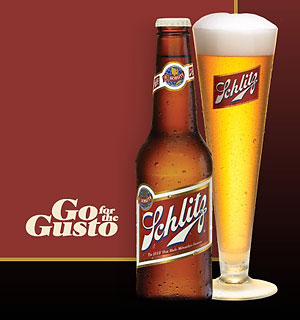 Not only did the beer come in its retro packaging, but it was also served in a handsome logoed pilsner glass. Although I certainly didn’t feel like I’d been transported back to the 1960s—a shitty decade if there ever was one—I did find the experience laid back and enjoyable: sitting in a nearly deserted, relatively old tavern as hazy sunlight filtered in through the windows on a comfortably cool late spring afternoon. And the beer itself, well, I found it drinkable, about the best you can say for any macro-produced American lager, whether it’s a 50-year-old recipe or not. It poured as clear as any filtered beer should, but a degree or two darker than your typical mass-market swill. The head was pure white, a finger high, and perfectly average. But—ho!—it left lacing as I drank it down. And it was an easy drink, with a very soft mouthfeel, smooth without that horrid off-taste that the Schlitz of today, along with its shit-beer brethren (Blatz, Old Style, Hamm’s, Busch, etc.), are plagued with. Instead it had soft, if muted, malt notes, but still without so much as a trace of bittering hops to be found.
I’d call it a step above “premium” shit beers—Budweiser, Coors, Miller Genuine Draft—but it’d still taste like water compared to the blandest craft pilsner like a Bell’s Lager or Capital Special Pilsner. But I could see why, what with the taste, the marketing campaign, and the tied houses, along with a myriad other factors of the day, why Schlitz wasn’t just the largest brewer of beer in America in the ’60s, but the largest in the world. Yet by 1980 Schlitz was dead, kaput, nothing more than a hollow brand that got swapped around like a Playboy in a junior high boys locker room.
The reason Schlitz went from king of the hill to roadkill in less than twenty years is a microcosm of what is wrong with industrial-produced beer. During the ’60s the beer industry was going through a wave of consolidation, much as it is today. Instead of giant global brewers fusing together into hideous Frankensteins, though, the industry was seeing regional breweries gobbling each other up to eventually form the behemoths that are left today. The pressure of retaining market share began to mount on all the larger breweries, including Schlitz. One of the techniques beermakers used to stay ahead was cutting costs, even to the detriment of their product. Brewers began adding adjuncts to their previously all-malt beers, creating a cheaper but watered-down product. Schlitz took that one huge, stupid-ass step further: they came up with a way to chemically shorten the fermentation process, allowing them to make more beer in a shorter time. The end product, however, tasted ungodly awful, with a pronounced chemical taste. Not only that, if it was stored improperly it tended to gelatinize into a snot-like blob. That was too much for even brand-addicted American consumers to take, and Schlitz went down the proverbial shitter.
Succumbing to market pressures?or greed?by bastardizing your product is a sure road to ruin.
Even though we’re talking about macro beer producers, there is a very clear lesson for the craft brewing industry in this little tale of woe. Succumbing to market pressures—or greed—by bastardizing your product is a sure road to ruin … or at the very least a road to irrelevance. Cutting corners, over expanding, compromising the integrity the initial vision, these are things that can happen when a brewer cares more about the business than the beer. Yes, I am aware that brewing and selling beer is, indeed, a business, but beer itself is not. It’s not a nameless product that can be seamlessly interchanged with any other widget. Schlitz, and the other brewers at the time, treated it that way though, and we got to see the end result of that: an endless stream of indistinct yellow fizzy water cut with a little alcohol for the last 50 years.One craft brewer that comes to mind regarding this cautionary tale is Capital Brewery. In the last few years they’ve ditched their authentic Bavarian wheat beer for the much blander Island Wheat, they’ve discontinued the insanely great Dark Doppelbock, and they seem to have watered down their groundbreaking Autumnal Fire. From a certain perspective, it looks like they’re dumbing down their lineup to appeal to a broader audience—like their first new beer in years, the ho-hum introduction of a pale ale. They’ve put together a couple of inoffensive entries in Prairie Gold and Baltic Porter, but in this Beer Dork’s opinion this once great brewery could be on its way to craft beer irrelevance.
But here’s to hoping the majority of craft brewers focus on what is most important when making business decisions: the beer. I understand that with the hop and malt shortage and the rising costs of production and distribution brewers are facing some of their toughest times ever, but even the most nostalgic of us wouldn’t want to relive the craft beer vacuum of the 1960s. Hang in their, folks. Keep it all about the beer, and, rest assured, we Beer Dorks will be there to drink it.