


Latest Reviews
Double Dry Hopped pseudoSueToppling Goliath
 Modus Vivendi
Wild Beer Co.
 Spaceman
Brewfist
Recent Articles
Outdoor Winter Tippling TipsStay safe from the pandemic and stay warm with these winter patio drinking tactics. Shameless
Craft brewer sellouts become as tone-deaf and underhanded as their new overlords. Great Taste Eve
Check out the burgeoning Madison beer scene the night before the best fest in country. Good Beer Makes Good Conversation
The effects of drinking beer worth talking about. archives »
January 12, 2009
Beer Diary:
Feel The Fire
Eddie and Jug finally and semi-definitively prove whether Capital Brewery?s Autumnal Fire recipe has been tweaked?or wrenched?from year to year.by Eddie Glick
So I got invited over to Jug Dunningan’s “house” the other night. I hesitate to use the word “house” when referring to where Jug lives. Sure, there’s four walls and a roof, and he spends most of his time there. But in all other aspects it resembles a brewery more than a house. First, you walk in and you about fall over a fifty pound bag of malted barley in front of the door. This is right next to a giant closet that is stacked with boxes and sacks of barley, wheat, rye, and a host of other adjunct grains. Then you get into the “living” room. There’s all varieties of fermenters in there: glass carboys, plastic ale pails, mini stainless steel vessels. All a-bubbling with his latest brews. There’s also a giant black spot on the wall where some piece of equipment burned up while he was out of town birding or hunting or getting married or some damn thing. When the cops called to tell him his “house” was on fire, he yelled “Is the beer OK?” Which, thank Jebus, it was. In fact, the firemen used the grain bag to prop open the door while they hosed the wall down.

Then you stumble into the kitchen, where, of course, there’s a fridge. (There’s also a coffee maker, which has been known to be brewing beer. I’m NOT shitting you.) You’d think there’d be beer in the fridge, but you’d be wrong. Instead there’s a bunch of bottles that look like beer, except they’ve got stoppers with airlocks jammed into them. These would be yeast cultures. My advice is don’t drink any of these if you happen across them. Sure, they’ll straighten out virtually any digestive problems you might be experiencing, but they’re a little … yeasty in the palate. Plus, Jug gets really pissed when you drink his house yeast. Not that I would know firsthand or anything.
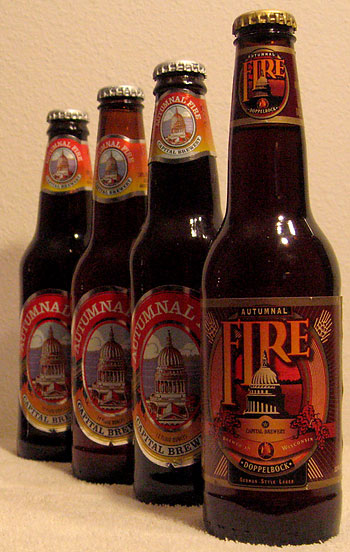
Anway, it’s not very often I get invited to Jug’s house—or anybody’s house, for that matter—and since it’s a bit of a haul to his place from my parents’, I decided to bring a special treat: a bottle of Capital Brewery Autumnal Fire from each of the last four years. You may recall from about a year ago that I tasted the 2005, 2006, and 2007 vintages side by side by side to see if they differed. It was my theory that Capital had not just tweaked the recipe from previous years, but changed it quite drastically by lightening it up. Or, as I’d like to call it, dumbing it down. My results were only slightly conclusive, since I couldn’t pin down whether the differences in the various vintages were more due to the aging process rather than Capital tinkering with the recipe. But now, with four years to compare, I think we’ve got some more concrete evidence.
First, a quick recap on the effects of aging on beer. It basically dulls hoppiness while accentuating malt and alcohol. All these beers were stored here in the basement, at a around 72°. Although you probably want to store beers at a cooler temp when cellaring, this is the best I can do until Ma throws out all her jars of dill pickles and lets me start using the root cellar. Like that’ll every happen.
Without further ado, into the fire we go …
The ’05 and ’06 versions pour a deep, dark, slightly viscous brown, with virtually no head. The ’07 Autumnal pours quite a bit lighter—a slightly cloudy dark amber, with a small, short-lived head. This year’s (the 2008, just to clarify) is noticeably lighter, bright and clear, a gorgeous iridescent dark ruby color, with a perfect finger’s worth of head.
Smell-wise, the first two years are super malty—on deep sniffs visions of boiling grain come to mind. Raisin-like notes waft out of the glasses in dark intoxicating waves. The ’07 has a huge malt/grainy nose as well, but nothing compared to its predecessors, and with only hints of the dark fruit. The ’08 version’s aroma is more dry and biscuit-like than grainy, and there are some very light hop notes at the far edges of the whiffs.
Once a brewer starts putting things like cost and marketability above the quality of the beer, then the brewer is moving away from being a craft brewer.
Like last year’s tasting, the ’05 is all thick maltiness; syrupy sweet overtones to a giant-ass, velvety smooth body, transforming into a boozy, warming finish. The ’06, however, wasn’t so lucky. Jug, after only half a sip, was the first to point out that it was way oxidized, almost to the point of being undrinkable. This isn’t the least bit surprising, since sometimes it can take only a matter of months before some brews get skunked this way. The ’06 bottle was moderately oxidized in last year’s tasting, so it could be that that batch was more susceptible, or maybe I got a sixer with a poor seal on the caps. Whatever it is, for tasting purposes the ’06 is pretty much useless for our experiments.The Fire from 2007 is lighter in body and sharper in the palate. The malt is quite pronounced, and there are more than hints of raisins and plums, although nowhere near what the ’05 exhibited. This year’s is even lighter, almost to the point that you’d describe the body as “medium,” with the biscuity malt aspects dominating, at least in the middle of the sip. Some sweet, dark notes lurk in the edges, but a hop and carbonation combo at the end provides a (comparitively, of course—Autumnal Fire is still a big beer) short, crisp finish.
And the verdict is … the recipe was, indeed, tweaked between the 2006 and 2007 batches. Hell, not just tweaked, but cranked. [Editor’s Note: Read the follow up to this assertion.] While the differences between the ’05 and the ’06 were fairly small—save for the oxidation—between those and the last two years is HUGE. I don’t think I’d say they were almost different beers—it is possible to pick out similarities—but there is absolutely not doubt that the malt bill has lightened considerably in the last two batches.
Autumnal Fire used to be a huge, challenging beer, but immensely rewarding to those who dared to finish a glass or two.
And so what? If Capital wants to tweak the recipe from year to year, that’s their prerogative. Frankly, it was great fun tasting the different vintages and sharing our thoughts on each. But what does concern me is the why for the tweak. Does the Capital brewmaster Kirby Nelson—and/or someone else calling the shots in Middleton—just like his Fire a little lighter and easier on the palate? If so, I don’t have a beef with that. There is, as the saying goes, no accounting for taste. But if it was for some other reason, such as, let’s say, because the accountants wanted to cut back on the barley bill or the marketing people thought they could get better penetration if the beer was more “accessible” to a larger pool of consumers, then I have a problem. A big fucking problem. Because once a brewer starts putting things like cost and marketability above the quality of the beer, then the brewer is moving away from being a craft brewer. And there’s only one way to go when moving away from being a craft beer brewer: a shit beer brewer.Capital has a long way to go before becoming a shit beer producer, but it is my opinion that the quality of Autumnal Fire has suffered in the last couple of years. It used to be a huge, challenging beer, but immensely rewarding to those who dared to finish a glass or two. Now, although still an amazingly good doppel, it has lost a lot of its bite, audacity, and, thusly, its rich reward. It is now just another very good beer in a market that increasingly has more very good beers.
After a mere four sips (and several gravity measurements—Jug has an awesome set of brewing tools) Jug was so disgusted with our revelation that he slammed his glass down and said, “That’s it. I’m not buying another Autumnal Fire again.” I’m not sure I’ll go that far. But the magic of that original sip of Fire has without doubt worn off. And we can only lament its passing.
Until Capital decides to tweak the recipe again …